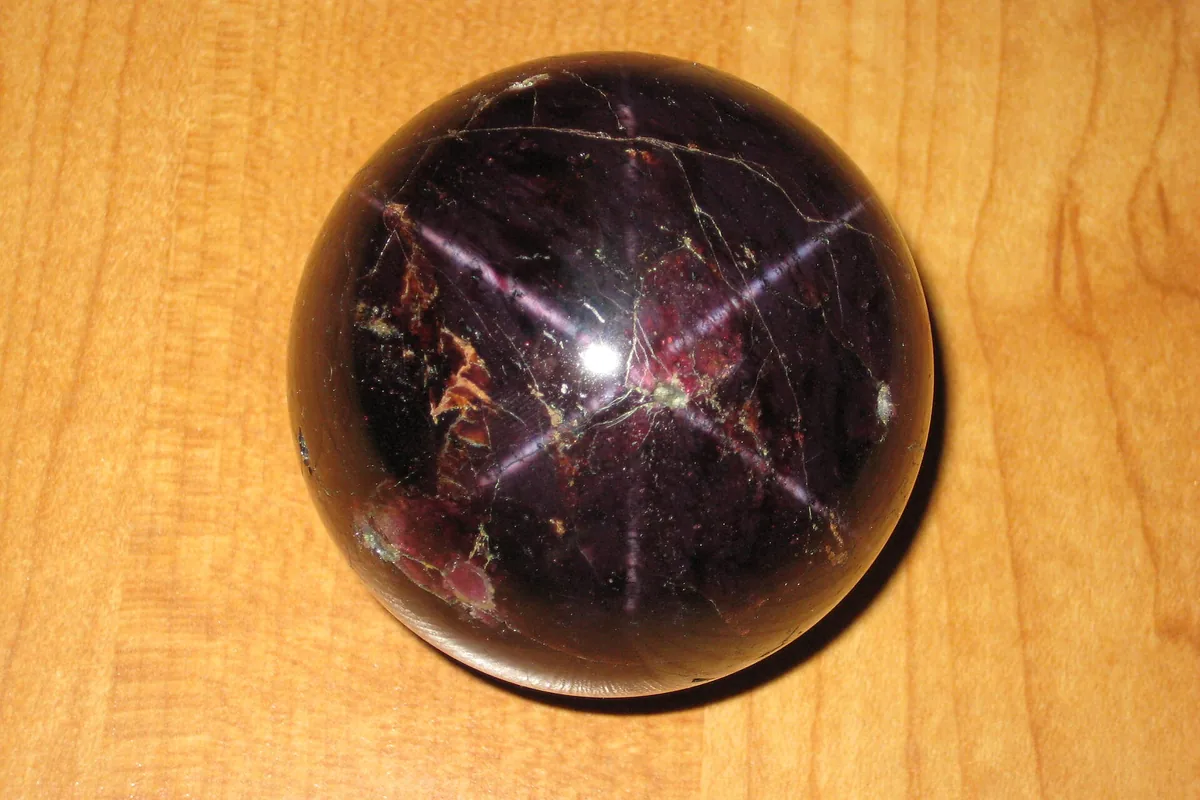
An Idaho star garnet is a garnet that can display a four- or six-rayed reflected star when properly cut and polished. Emerald Creek Garnet Area is the state’s best-known managed public collecting site, but it closed early in 2026 after its supply of excavated material was depleted. Check the Forest Service’s current status before planning any gem-hunting trip.
This is an important exception to the usual summer-activity advice: a published seasonal schedule does not override a closure. The official Emerald Creek page, updated July 9, 2026, reports the early closure. A future reopening should not be assumed until the agency announces it.
What makes a star garnet different?
The star is an optical effect called asterism, not a pale mineral vein painted across the surface. Washington State University researchers identified tiny inclusions of rutile, a titanium-oxide mineral, as the cause in Idaho garnets they studied. The orientation of those microscopic needles influences whether the reflected star has four or six rays.
Cutting matters as well. A lapidarist normally shapes a suitable stone into a rounded cabochon rather than a faceted gemstone. The polished dome and the orientation of the material help reveal the effect under a concentrated light source. A rough star garnet does not necessarily show an obvious star while you hold it at a sluice box.
Idaho designated star garnet its state gemstone in 1967. Idaho and India are especially associated with deposits producing these stones in quantity. Avoid the broader claim that asterism or star garnets can exist nowhere else: that is not necessary to explain why Idaho’s material is distinctive.
Where is Emerald Creek Garnet Area?
The Forest Service site is in northern Idaho, in the Idaho Panhandle National Forests’ St. Joe River recreation region. This is not a Boise day-trip stop or a southern Idaho attraction. Build it into a north Idaho itinerary only after confirming access, and use the official directions rather than searching for an informal creek pullout with a similar name.
For the wider regional plan, see our northern Idaho travel guide. A visit to Moscow can provide a separate town-focused part of a regional trip, but do not book lodging around a collecting session that has not actually been confirmed.
How collecting works when the site is operating
Emerald Creek is a managed gravel-processing activity, not an invitation to dig anywhere along the stream. The Forest Service supplies stockpiled garnet-bearing material so visitors can sift and sluice without excavating the creek bed themselves. The agency explains that the system protects water quality and aquatic habitat while improving visitor safety.
Under the published operating rules, tickets are reservation-only through Recreation.gov. Walk-up permits are not sold. Tools are provided on site, and the Forest Service asks visitors not to bring personal sifters, shovels or buckets. Each participant needs the appropriate individual ticket and permit; do not assume one booking automatically covers your entire group.
The current Forest Service listing sets a two-pound garnet limit per person and one permit per person per year. Older brochures and community pages can show different limits or operating days. Follow the current agency rules and the terms on your actual reservation, not a screenshot from an earlier season. This guide deliberately leaves out a fixed fee because the next operating season may have different booking terms.
Plan for the walk from parking and a hands-on session
Recreation.gov describes parking a half-mile from the activity site, followed by a walk up the access road. That approach is part of the visit, not an optional scenic detour. If someone in your group has a mobility limitation, contact the operator about the current arrangements before reserving; do not infer accessibility from the presence of a parking area.
The booking page says there is no drinking water at the site and shade is limited. Bring water, sun protection, sturdy shoes and clothing that can get wet or dirty. Print the required reservation information and download directions before leaving service. Treat poor connectivity as a planning constraint rather than relying on a phone to retrieve a ticket at the entrance.
Pets are not allowed in the recreation site, and the Forest Service restricts entry to trained service animals. The agency also warns that parking does not provide shade for animals left in vehicles. Arrange a different plan for a pet rather than bringing one and trying to improvise at the gate.
Can you collect outside the managed garnet area?
Do not use a closure as a reason to search adjacent ground. Recreation.gov explicitly states that garnets cannot be collected outside the Emerald Creek Garnet Area recreation site or while the site is closed. A mineral occurrence on a geological map is not permission to enter private land, work a claim or dig in a protected stream.
If your aim is simply to own an Idaho garnet, buying a documented specimen is a different option from collecting one. Ask a seller about origin, treatments, whether a star is actually visible, and whether the stone is rough or already cut. A large rough stone is not a guarantee of a clear star or a profitable finished gem.
A sensible backup plan for north Idaho
Keep the rest of the trip worthwhile without a reservation. Our Idaho things-to-do guide can help you compare activities, while Mineral Ridge offers a separate north Idaho hiking idea. Lake Coeur d’Alene or, on a longer regional route, Lake Pend Oreille can anchor a lake-centered itinerary. These are independent destinations, not alternate garnet-collecting areas.
The practical order is simple: verify that Emerald Creek has reopened, read the current reservation terms, secure the correct tickets, and only then build a collecting day around it. If the site remains closed, enjoy the region without treating old operating calendars as a promise.
Questions before you go
Is Emerald Creek Garnet Area open?
The Forest Service reports that it closed early in 2026 because excavated collecting material was depleted. Check the official site for a subsequent reopening before traveling.
Will a rough Idaho garnet show a star?
Not necessarily. Asterism depends on suitable internal inclusions, lighting and how the material is oriented and cut. A lapidarist generally cuts suitable material as a rounded cabochon.
Can you dig in Emerald Creek without a reservation?
No. The managed site requires reservations when operating, and Recreation.gov prohibits collecting outside the recreation site or while it is closed.